Friday, July 1, 2011

Paris in Monochrome

Because Paris makes monochrome look good.


Dog-walking

Rules concerning dogs in Paris: No self-walking dogs, and no walking your dog in a jaunty fasion. That is all.


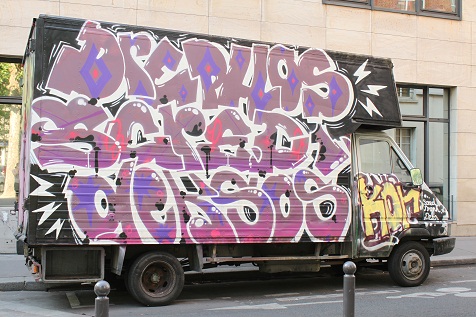
Graffiti Vans

I'm not sure what the deal is with vans and trucks - do the flat surfaces just attract graffiti artists? I'm not sure if I've seen a van without graffiti yet ...


Graffiti #2

More graffiti ...


Graffiti # 1

One of the first things I noticed about Paris, apart from the fact that it looks like a perfect model city from the air, was the graffiti. It's everywhere! And actually kind of cool.


Bonjour!

I hear the drums echoing tonight, but she hears only whispers of some French conversation ...
Um, Toto? I don't think we're in Africa anymore.
I landed in Paris 6.30am on Monday morning, spent 3 hours making my way to Gare de Lyon by bus, and then realised I had no idea how to find the hostel from there. By chance, my sister and her friends had gone to that very station looking for Internet access and as I dragged my luggage up the steps she bouced up to me, looking glamorous in a little black dress. What chance! Once I'd offloaded my bags we began exploring Paris together.

This new adventure is so completely different to Africa that I'm still not quite sure what to make of it.

At least the coffee's good!


Sunday, June 26, 2011

Long-wa

Spending the night in Lilongwe, the capital of Malawi, I was woken up at 6am by a loud American talking to his friend on the phone: "Yeah, we're in Malaaaaari! We're in Long-wa, or Lang-wa, or somethin' ... "

Photo from Lake Malawi (not Long-wa)

Monday, June 20, 2011

Snore like a mosquito

Half asleep on the top bunk in a four-share dorm, I became convinced that I was being harrassed by a mosquito. Having slept every night for the last six weeks under a mosquito net, I was feeling a little exposed - and I'm sure Livingstone mosquitoes carry malaria just as well as those in Katete.

Flailing my arm sleepily about my head, I was unable to get rid of that whiny, buzzing sound - and in my dreamlike state decided that the mosquito must be in my ear.

And that's how I woke up at 3am with my finger in my ear, only to realise that the whiny, buzzing noise was my middle-aged American room-mate's snoring. And even when I was awake, it sounded like a mosquito. Special!

What's an Adelaide?

The store holders at the little souvenir shops around Livingstone are very good. They'll usher you in to their stall, "come in my sister, I show you what I've made. Looking is free, touching is free" and "ten different families rely on this one store, my brother made this, my grandfather paints these, nobody has bought anything this whole day, how about something small?" It's very effective.

They also try and connect with everyone personally - "Where are you from? Australia? Down Under! G'day mate! You are from Sydney? No? Melbourne? No? Perth! You are from Perth! No? Then from where?"
"Adelaide"
"Abba-what?"


Holidays

I've finished my six-week elective at St Francis Hospital Katete, and am now officially on holidays. I still have at least three more stories to share from St Francis - a little story of success, a story of hope and a story of heartbreak - so hopefully you'll see why my African elective has given me the best and worst of medicine so far. I'll post them all together in due course.

But for now, I'm at Livingstone enjoying Victoria Falls for a few days before heading to Malawi, where will end my little African adventure. I'm more tired now than I ever was during elective, but there are so many things to do and it seems like a waste to sleep!

Here's some advice for seeing Vic Falls:

1. Bring the best camera you know how to use
2. Bring a waterproof camera as well if you have one
3. Take a Microflight over the Falls, they look so different from above
4. Don't be afraid to get wet. The waterfall consists primarily of water (little known fact)
5. If you can't afford to stay at the Royal Livingstone, go there for High Tea and watch the zebras graze by the pool
6. If you can afford to stay at the Royal Livingstone ... wow. Donate some of your millions to starving children in Africa please
7. GO TO LIVINGSTONE ISLAND


Livingstone Island

This morning I stood on the edge of Victoria Falls and looked down.

If you ever go to the Victoria Falls, one thing that you must - MUST - do is go to Livingstone Island. We thought we'd seen the Falls yesterday when we walked around the park, but we hadn't. Not really. Here are some of the photos from today!


Sunday, June 19, 2011


Some of my favourite safari photos ...


Ascites

So many patients on the female medical ward have ascites. Tiny, wasted women with giant, distended bellies lie in the beds awaiting treatment. Sometimes we can treat the cause – we have plenty of medications for heart failure and tuberculosis. Those with hepatic failure or malignancy can only be treated symptomatically, such as with an ascitic drain.
My friend did an ascitic tap on one woman with malignant ascites. The woman was keen to go home, but knew she needed her belly drained first. As my friend prepared the equipment, I brought in the screens – the woman immediately jumped up on the bed and drew her shirt up over her giant belly.

 
My friend inserted the cannula into the woman’s tense belly and attached a giving set, running the tube into a large metal bowl. Immediately, clear yellow fluid began draining into the bowl, flowing at quite a rapid rate. The woman stared, fascinated, as the bowl began to fill with fluid from her own belly. She began talking to us questioningly, but none of us know much of the local language yet. Was she in pain? Did she want us to stop? She didn’t look too upset.

Eventually we managed to call over a nurse to interpret for us. He smiled before relaying the message, “she wants to know if she’s allowed to touch the fluid. She wants to feel it”.

Friday, June 17, 2011

Well Done

The oldest doctor here is a 70-something English professor who is always dressed resplendantly with a new tie or bowtie for every day of the week. In his downtime he either paints scenes from the hospital, or sits on his porch reading the paper and smoking his pipe. He doesn't ever get flustered, he is a wealth of knowledge on Africal diseases, and he is very encouraging to the students.

His favourite praise is "well done" as in, "You did a lumbar puncture - well done" or "you got a chest X-ray on that patient - well done". It's nice to get praise, until you realise just how easily he dishes out the compliments, "you've been here for two days already - well done" or "you arrived on Wednesday? Well done".

Um ... thanks!

Thursday, June 16, 2011

Burkitt's Lymphoma

I have been privileged to see many strange and wonderful diseases here at St Francis. Pathologies more advanced than the examples in textbooks, classic TB, advanced cancers, meningitis and a sample of the manifestations of HIV. There are a few things I wish I hadn't seen, although I'm probably better for the experience. One of the worst so far is an HIV positive 11-year-old girl with Burkitt's lymphoma.

We don't know how she contracted HIV - that's not relevant now. The large tumour in her abdomen, and the large tumour that is deforming her face and destroying her teeth are more of a concern at the moment. She lay there in pain on the morning ward round as we all crowded around, prescribed morphine, and decided how she would die.

Would we give her chemotherapy? It's just a short course, and we could do it here, but with her HIV, could her immune system cope? With such advanced disease, her chance of remission is incredibly high, so is it worth it? Save her from the lymphoma so she can die from some HIV-related illness? The alternative is to palliate an 11-year-old and wait for a few months for her airway to obstruct, her abdomen to completely fill with tumour and for her to die gasping for breath around a collection of rogue cells that we could have killed off for her.

In the end she got her chemo and we were all thrilled to see the tumour shrink over just a few days, so that she was able to eat, smile and giggle again. I hope it lasts.

Wednesday, June 15, 2011

Two Canoes

"He who paddles two canoes, sinks" is apparently a Zambian saying warning of the dangers of polygamy - it can be found all through the HIV magazines. Perhaps it should also be used at the marriage celebrant's office.

The male medical ward had an interesting admission last week - a 30-something man who'd come in with excruciating abdominal pain, pin-point pupils and bradycardia. He'd taken rat poison, which in Zambia contains organophosphates (not warfarin like at home). Memories may or may not have come flooding back from our very first PBL case. He was given atropine to good effect and has been discharged home.

Why would an apparently healthy young man take rat poison, you might wonder? Apparently his two wives had been fighting, and he'd gotten upset and had taken the rat poison. Too many canoes.

Tuesday, June 14, 2011

Translator

I sat in OPD with Gustav, a Norwegian medic. Our translator was an amiable woman with questionable work ethic. She yawned throughout, occasionally wandered off, and sometimes had to be asked twice to translate for us.

At one point she started picking her nose, completely unashamed, really digging her finger around and checking curiously to see what she'd dug out.

But she was nice, and friendly, and got on well with the patients. The second-last patient didn't even mind when she interrupted the doctor's questioning and exclaimed, "I need some medicine Gustav!" whilst filling out a prescription form for herself.

Ignoring the actual patient, she started describing her mouth ulcers in great detail. And nobody minded. Welcome to Zambia?

Monday, June 13, 2011

Public Health, Public Health

Public health messages are very important here. There are billboards everywhere, and magazines devoted specifically to the subject can be found on most nurses' station desks. As you would expect, most of these messages concentrate on HIV and AIDS. My favourite billboard is a picture denoting Abstinence, Condoms and Faithfulness as "life-saving boats in an AIDS flood". Most patients are sent for VCT (voluntary testing and counselling) so that they know their status (HIV negative or positive). There are centres for male circumcision, although the message still hasn't come across that circumcision won't PREVENT HIV infection; it merely decreases the risk.

Unfortunately, with most messages concentrating on HIV, a few things have fallen by the wayside. Rubbish is everywhere. At the bus station, people will buy plastic bottles of soft drink and then throw the bottle out the window, so there is a layer of plastic over the entire area.

Basic hygiene such as handwashing, and covering one's mouth when coughing, generally does not occur. I find this especially disturbing when half the adult population is infected with TB, and my friend and I are convinced we'll have TB when we get home.

Whilst women's rights are improving, women's health is not widely promoted and I have seen two cases of advanced breast cancer so far. Both women had noticed a lump in their breast growing over about a year, and both had cancers eroding through the skin. They had huge axillary lymph nodes and one even had arm pain from brachial plexus involvement. We sent them to the surgeons who would tell them that their prognosis was not good, as both cases were beyond surgery. You might wonder how they let themselves get that far, but these women genuinely had no idea what was wrong with them.

It's hard to say whether the public health message should be broadened, or perhaps if they should try and get the HIV message across and that epidemic under control before concentrating on other health care promotions. Either way, it's opened my eyes to public health.

Disappeared

"Oh, you're in Year 12! Fantastic! You speak English!" we were all unduly excited about the Zambian schoolgirl's ability to communicate. Unfortunately she had a sore throat and refused to talk much, however her school friends who came and visited helped us out with her history.

During the afternoon, my patient in the next bed went missing for a few hours. I really needed to do a blood test, so I asked one of the girl's friends if she knew where my patient was.

"Yes I do" she smiled

"Oh good!" I said, relieved, "Where is she?"

"She has disappeared"

Green Card

The "green card" is a patient's most prized possession in hospital or outpatients. It may be torn, worn and dirty, but a patient will almost never lose the card. On it is written their personal details, hospital number, and a short discharge summary from each time they've been in hospital.

It's much easier looking at a green card than searching through a computer program for admission details or discharge summaries. It also has all of their outpatient encounters written on neatly torn pieces of paper stapled to the green card. As soon as somebody goes to outpatients, the nurses do a blood pressure, temperature and weight - more consistently than your average family GP.

Patients are also in charge of their own X-rays, which they collect as soon as they are done and carry to outpatient on metal drying frames. They keep them safe and neat and bring them along to every medical encounter from then on.

Perhaps it is because they don't have much other paperwork for things to get lost in, but patients are much better at looking after their medical records than we would be. It may be 'primitive' keeping everything on a single green card, but the system works. And I like it.

Saturday, June 11, 2011

Tuberculosis

I thought I knew about tuberculosis. It was a lung disease which made you cough up blood and then die, like Nicole Kidmann's character in Moulin Rouge.

Then on Infectious Diseases rotation, I heard about an old man who'd gone for elective TURP and the next day started complaining of shortness of breath and shoulder pain. He'd had TB as a young man in Germany and it had lain dormant IN HIS PROSTATE until the TURP, when it had seeded through his bloodstream to his lungs and shoulder.

Here in Zambia there is TB everywhere, especially in HIV patients. It occurs in extrapulmonary sites (haven't seen a TB prostatitis yet) in 10% of non-HIV patients, and 70% of HIV-infected patients.

We had a lady with TB adenitis - massively swollen cervical lymph nodes due to TB infection. They'd started draining pus so she'd had someone open them up with a knife. Of course they'd become infected so she came in with open, purulent sores on her neck. More swellings appeared, so she was taken to theatre for debridement and drainage - pretty much the same thing she'd done at home, just with a CLEAN knife.

Another lady came in with a huge, swollen right leg and pus draining from a slmall ulcer near her knee. The joint was infected with TB, so instead of being hot it was cool, although it was very puffy and the joint was essentially destroyed by the infection. Her best outcome would be surgical fusion of the knee after the infection had cleared up.

There are patients with classic TB on their chest X-rays. They come in very sick, but their prognosis is usually very good if they complete their course of antibiotics (which goes for months). Good to know.

The Hill that was a Mountain

Well, I’ve climbed a mountain in Africa. Sort of. It’s actually called “Katete Hill”, but it was hard work walking up it, and on that basis I’m going to put it in “mountain” category.

My friend and I took the hike there today with 7 other students who are currently placed at St Francis Hospital. Usually with a biggish group you can usually guarantee that you won’t be the slow one, but I was pretty far back on our climb up. Now I’m not making excuses, but I had kind of planned to do exercise before coming overseas, and then I came down with pneumonia, so there is a reason for my lack of fitness. I think it’s called laziness.

It took us just over an hour to reach the top – it’s not a very long walk, but it’s quite steep for most of the way, and the ground in some places is just red dust with fine rocks which slip out from underfoot. There is no path to the top; you just have to find your own way. A good way is to start at the bottom and always walk upwards. It worked for us. We had to be quite careful though, because between most of the trees is a spider web, usually with a spectacular-looking spider in it. I took some photos, which I unfortunately can’t share with you due to lack of reliable Internet.

My favourite spider was a small flat one that looked a bit like a crab – it actually looked like it should have been a ground spider, but there it was in a web at face-height. My other favourite was an enormous black spider with bright yellow stripes and sharp-looking legs. As my friend put it, “I wouldn’t like that one walking on me”.

It was a hard walk, but the view from the top was a worthy reward. We could see the landscape of Zambia stretching out in each direction – flat land to the North and West with low hills in the distance, more hills (mountains) to the South and East. There was very little traffic on the road below – maybe one or two cars passed in the hour we sat there. The only sounds were the birds and various insects around us, and singing from the small village below. Beautiful.

Wednesday, May 18, 2011

Bedsiders

Every single patient admitted to St Francis has a “bedsider", usually a relative, who looks after them during their stay. If we are lucky the bedside will speak English and act as an interpreter, but this is rare in a poor rural area where very few residents have attended secondary school.
The bedsider performs basic tasks of caring for their patient, such as feeding and washing, leaving the nurses to take care of drugs and procedures. Almost all of the bedsiders are female – I didn’t really pay much attention to this in the female ward, but I really noticed it when I entered the male medical ward and discovered that most of its inhabitants were female bedsiders – about 3 for every male patient.
 There is a single male bedsider in the female medical ward at the moment. His wife is in with gross ascites due to liver cirrhosis, and has a hugely distended abdomen with about 25L of fluid. He helps her dress, helps her sit up, and washes her dishes. When one of the doctors drained some fluid from her abdomen, the hole from the drain kept leaking fluid, soaking through the gauze and running onto the floor. Her faithful bedsider took a mop and quietly mopped up the fluid which was running along the floor.
Thank God for bedsiders.

Monday, May 16, 2011

Taxis

As far as I can tell, taxis are local people who own a car and wish to make money from it. Perhaps they have special licences but it’s hard to tell. As you step out into a public place (like exiting an airport, crossing the border or getting off a mini-bus), you are immediately swamped with taxi drivers. The first one to grab your bag wins the fair, apparently, and so they all battle over the luggage.
Like the mini-buses, taxis usually only leave when they are full (hence all the guide books refer to “shared taxis” – there’s really no choice).
 Our mini-bus from Chipata to Katete, a 16-seat van, waited 2 hours before it left the bus station. For the last hour all the seats were full, but people kept coming along needing a ride, so the driver kept cramming passengers in. By the time we left there were 27 passengers on board, including 2 screaming babies. A colourful ride indeed.
EDIT: We hired a driver to take us to Chipata, a 90km trip to from Katete. On the way we were stopped by police and he was told of for “pirating”, or acting as a taxi illegally – they wanted him to paint his car blue to mark it as a real taxi. I’ve never seen a marked taxi, this is the first I’d heard of it. He had to pay a K54,000 fine (about $15) which I think was more of a bribe, before we were able to move on.

Sunday, May 15, 2011

Medicine

I don’t know what I’d expected from rural Zambia, but the medicine here is really not too different from home. There is a lot of malaria and tuberculosis of course, and about 80% of the patients are HIV positive, but apart from that the common conditions are the same as home.

My friend and I are currently on the female medical ward “St Monica”. We have patients in with pneumonia, stroke patients, a woman with ascites from liver cirrhosis, a young woman with pericardial effusion, and a few with diarrhoea. I think the threshold for admission might be a little lower than home, because most patients live remotely and don’t have transport.
 
The ward setup is a lot different – you don’t get a private room unless you happen to be the only measles patient in the isolation ward. For most patients, the beds are lined up next to each other along the walls of the ward. There are screens for privacy during procedures such as lumbar puncture, catheterisation and pericardiocentesis (there have been two since we’ve arrived). Normal examinations are just done in front of everyone.
 
Apparently it is quite acceptable to discuss medical conditions in front of a large group, because traditional healers would have everybody in the same room in a circle, and they would go around discussing their ailments.

Similarly, the outpatients clinic is conducted in a small room with three or four doctors all working at once with different patients. There is a single examination bed behind a curtain, and two doctors will usually share a desk – one on each end. Privacy is not even optional, but nobody seems to mind.

Spare Tyres

Our taxi driver from Lilongwe airport manoeuvred between two cars which had been stopped by police on either side of the road. Curious, I asked him what was being checked.


“Licences. And these (tapping on his car’s registration sticker). And spare tyres.”


“Spare tyres?” I questioned


“Yes, if you do not have one, you get arrested. They say if you don’t like someone, you should steal his spare tyre”


Interesting, that people can ride on the back of trucks, our taxi didn’t have functional seatbelts, and many cars have massive cracks across their windscreens, and a spare tyre is the thing that could get you arrested.


That said, our driver from our accommodation in Lilongwe to the bus station carefully arranged my friend and I to keep all the weight off his completely flat tyre. Perhaps he was saving his spare for a police check.

Saturday, May 14, 2011

Money

I always find foreign money something of a novelty. I took out some US dollars before the trip, which do not seem like “real money” at all. By the time I’d landed in Africa the notes had all crumpled and looked like they were about to fall apart.

I bought a coffee in Johannesburg airport – they happily accept US currency, but can only give change back in local money. I’m not sure how it worked out, but I paid $5US for my coffee and received 50c South African in change. I also discovered that the 50c was magnetic when I found it later stuck to my MP3 player.

Withdrawing some cash from an ATM in Lilongwe, Malawi, I was fascinated by the K500 notes (500 Malawi Kwacha), the largest denomination I’d ever seen ... until we crossed the border into Zambia and I withdrew K200,000 from my account (about $40AUD) and was rewarded with K50,000 notes. Amazing!

AFRICA!

I'm in Africa!!

My friend and I (well mostly my friend) have been organising a medical elective term in Zambia since early last year. She's been emailing, we've been researching and shopping, and on Saturday I even started packing - with the help of my boyfriend and his amazing tetris skills.

There wasn't much time to really prepare - we finished our Term 3 rotations on Friday and left the country on Monday, so it was a little bit hard to get excited as we frantically packed our bags.

Even on the plane, it was hard for reality to sink in. 6,000km trip to Kuala Lumpur followed by a 6-hour stopover (our plane was delayed by an extra hour). We slept on our backpacks in the airport and waited for our flight to Johannesburg, which was delayed by an hour, and then I slept for the 10-hour flight, only waking for meals and falling asleep by the time the tray was taken again. On the plus side, we arrived in the morning and I wasn't too jetlagged.

But now we're here in Katete, Zambia, staying at the St Francis Hospital and helping out as much as we can there. My friend and I are both on the female medical ward, "St Monica" for the time being because that's where the fewest medical students are. There are about 15 students at the hospital at the moment, mostly from England and the Netherlands, although most are leaving in a few weeks so we will probably move around the hospital to wherever we are needed most.

I'll try and share some of the stories here.

Monday, May 2, 2011

Infectious

Some might say that I'm taking my Infectious Diseases rotation a little too seriously. I turn up early for the morning ward rounds, I take many pages of notes, I gave a lunchtime presentation, and I know enough about the third cranial nerve anatomy to ask questions that stump the consultant (his fault, he made me look it up). I write in the progress notes, I examine patients, I participate in the team meetings, and I go and see consults.

Oh, and I have pneumonia.

I've been coming in every day with a hacking cough, making my presence felt throughout the hospital. I really should have stayed home, but nobody said that was okay, so I kept on coming in. Pretty dedicated, you might say.

But then I made a fatal error last week and went to a compulsory workshop without informing my supervisor.

The very next day, I was called in for a meeting with absolutely no warning and berated for my "disappointing lack of attendance". Had my supervisor told me off for spreading germs throughout the hospital, I would have understood. Had he focused on my appalling lack of knowledge of antibiotic use, that would have made sense. 

But he was disappointed in my attendance. 

So disappointed that he might just fail me.

Maybe I should cough louder so he knows I'm here.

Signs of Pain


How will you know when your older patients are in pain?

Will it be the classic head-in-hands posture?
The downcast expression?
The phrase, "I'm in pain?"

Will you recognise the signs?